National Lung Cancer Screening Program
Telstra Health, 2024
Client
Australian Government - Department of Health
Services
Product Design, Strategy, Digital Experience
Almost 50,000 Australians with a high risk of developing lung cancer have been screened for signs of diseases since the program launched on 01 July 2025. Simplified the screening intake of data for internal operators to manage the call servicing reduction to 20% of time.
My roles
- •Established Population Health Solutions Figma Design Library of assets and components for the National Cancer Screening Register web browser platform.
- •Research, defined, designed and refined the user experience (UX) end-to-end feature solutions for the internal operators use to managing the various Cancer Screening programs.
- •Conducted qualitative and quantitative data research with internal users, stakeholders, and other teams across the enterprise business to shape consistent software product for Population Health's services.
Product impacts
- •Delivered design prototypes and wireframes from co-design workshops with stakeholders.
- •Developed reusable journey maps to identify value chains across the enterprise.
- •Established Population Health Solutions Personas and enterprise information architecture of Population Health's digital channels.
Establishing a scalable Design Library for numerous Screening programs
To comply with non-disclosure agreements, all confidential information has been omitted and obfuscated. All information on the case study is Fiona's own interpretation for recommendations which does not necessarily reflect the views of the company.
The National Cancer Screening Register needed to uphold another new screening program into it's database. During then the Head of Product for Population Health Solutions needed a Designer who can lead supporting the features for the legacy data platform whilst rebuilding a new centralised platform experience for Population Health Market.
Modeling the Present State
- •Information architecture
- •Component assets
- •Workflows and service blueprints
Segmenting end-users and identifying pains
- •Application Specialists support tickets
- •Reduce the scattered use of softwares across the department
Data was scattered everywhere due to the screening programs structure. Cervical screening data was manually monitored and had extensive complexities that caused a lot of the internal end-users (contact centre and Clinical Program specalists) to manually assess on the data whether outreach with the public-facing customer (participant) or healthcare provider is needed and the data had to reflect correctly in the National Cancer Screening Register. Bowel cancer screening data was well segmented and for Lung cancer screening data was to be automated.
Iterating through artifacts
- •Information architecture
- •User flows
- •Wireframes
- •Design Library
I worked with Product, Application Specialists and Clinical teams to co-design on the feature enhancements to the legacy screening register platform for our internal end-users (contact centre teams) for them to be able to manage the automated Lung cancer data. We defined the internal end-users workflow end-to-end from the automated communications (letters, text messages) to the manual contact between the Internal end-user and healthcare provider. The internal end-users expressed that managing the Cervical screening program data with another software application (Microsoft Lists) to use in their manual workflow is chaotic.
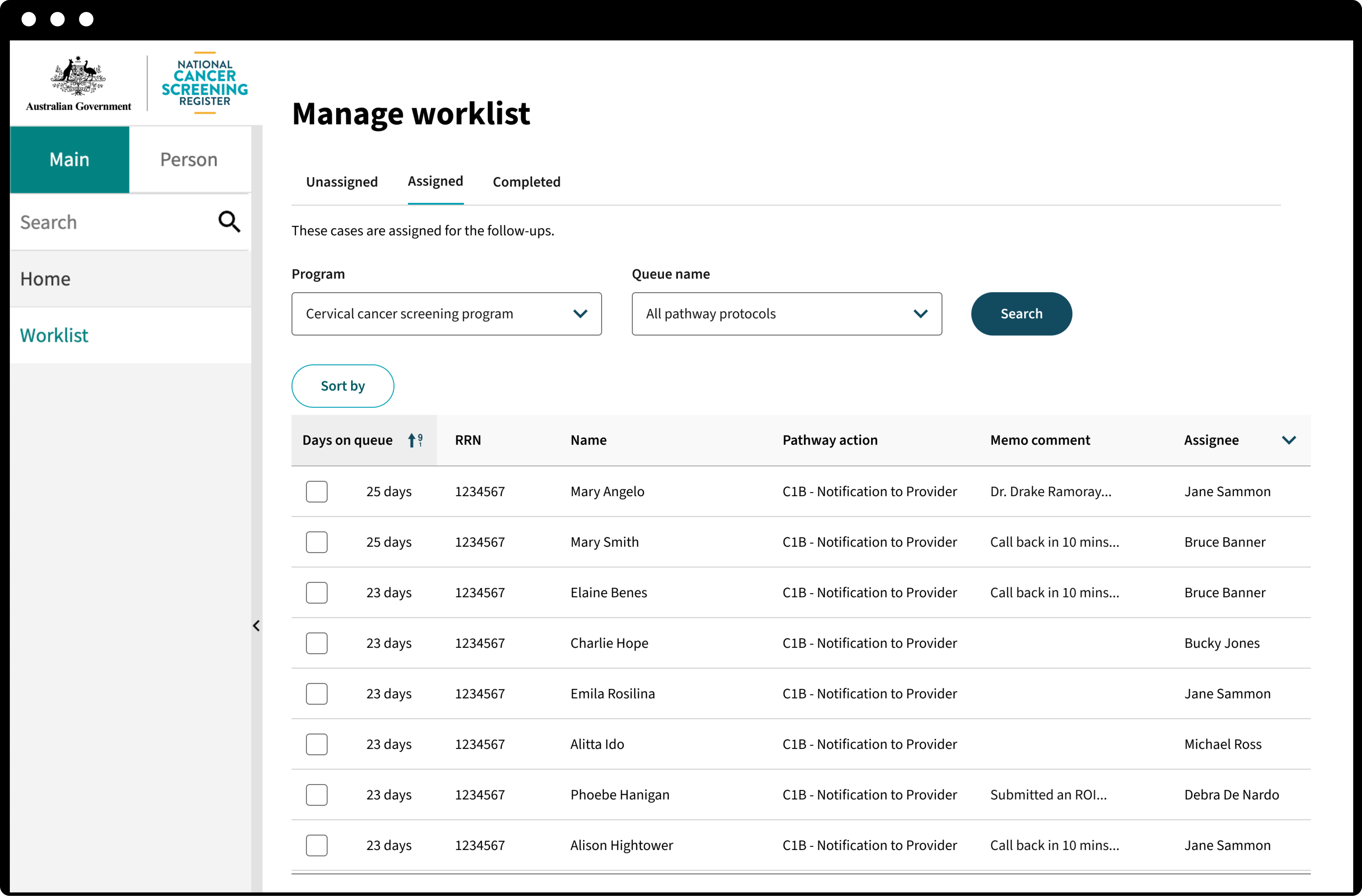
Context: Managing an additional screening program — National Lung Cancer Screening
The National Lung Cancer Screening Program experience was going to have automation in the workflow. Therefore some manual control needed to be given to the internal (contact centre) end-users to override on communications going out to public-facing users (participants) and customer-facing users (healthcare providers).
Problem
During the time I joined Telstra Health, there was no specific workforce in the internal (contact centre operations) established yet to overseeing the manual processes of follow-ups for the Lung Cancer Screening program, whereas they had sub-groups overseeing the Cervical and Bowel cancer program inbound and outbound workflows from communication to health stages of the public-facing end-user (also known as Participant).
Due to Telstra Health's legacy platform for the National Cancer Screening Register, a lot of the Contact Centre workflows needed to have manual maintenance. It could not completely be automated and the human workforce was present to oversee the data for each cancer screening program. Therefore, I could not completely replace the core workforce service of the National Cancer Screening Register.
Process
I needed to understand the entire Population Health Solutions software platform, and I mapped with an Application Specialist the information architecture of all interconnecting channels that the public-facing, customer-facing and internal-facing end-users would interact and engage with the National Cancer Screening Register.
I facilitated a co-design workshop to get aligned clarity with the Clinical stakeholders, Internal-facing end-users, Product, Application Specialists to decide and pre-approve on the features for enhancing the legacy platform to uphold what the interal-facing end-users have to control managing the Lung cancer data. All decisions were documented in a Decision Registry to make sure that not a single question or assumption was left open or unresolved.
Outcome
Iterated on the low-fidelity designs from the workshop into high-fidelity Figma prototypes and had Product, Application Specialists, Engineering syncs to review and make sure that the features are feasible to building into the legacy platform. Any issues or concerns were documented in the Decision Registry, espeically when some components were out of scope.
My design intentions was to make sure that Internal-facing (contact center) end-users would not have to open other software applications like Microsoft Excel or Lists to manually filter through the data and have dispersed data files in various locations whether it could on one individual's personal OneDrive or locally in their hardware device, when it should be all collated and stored in the existing legacy software.
While the automations were handled by the developers, I made sure that the Internal-facing (contact center) end-users are enabled with manual controls to override on the automated logic, such as skipping some postal correspondences or text messages.
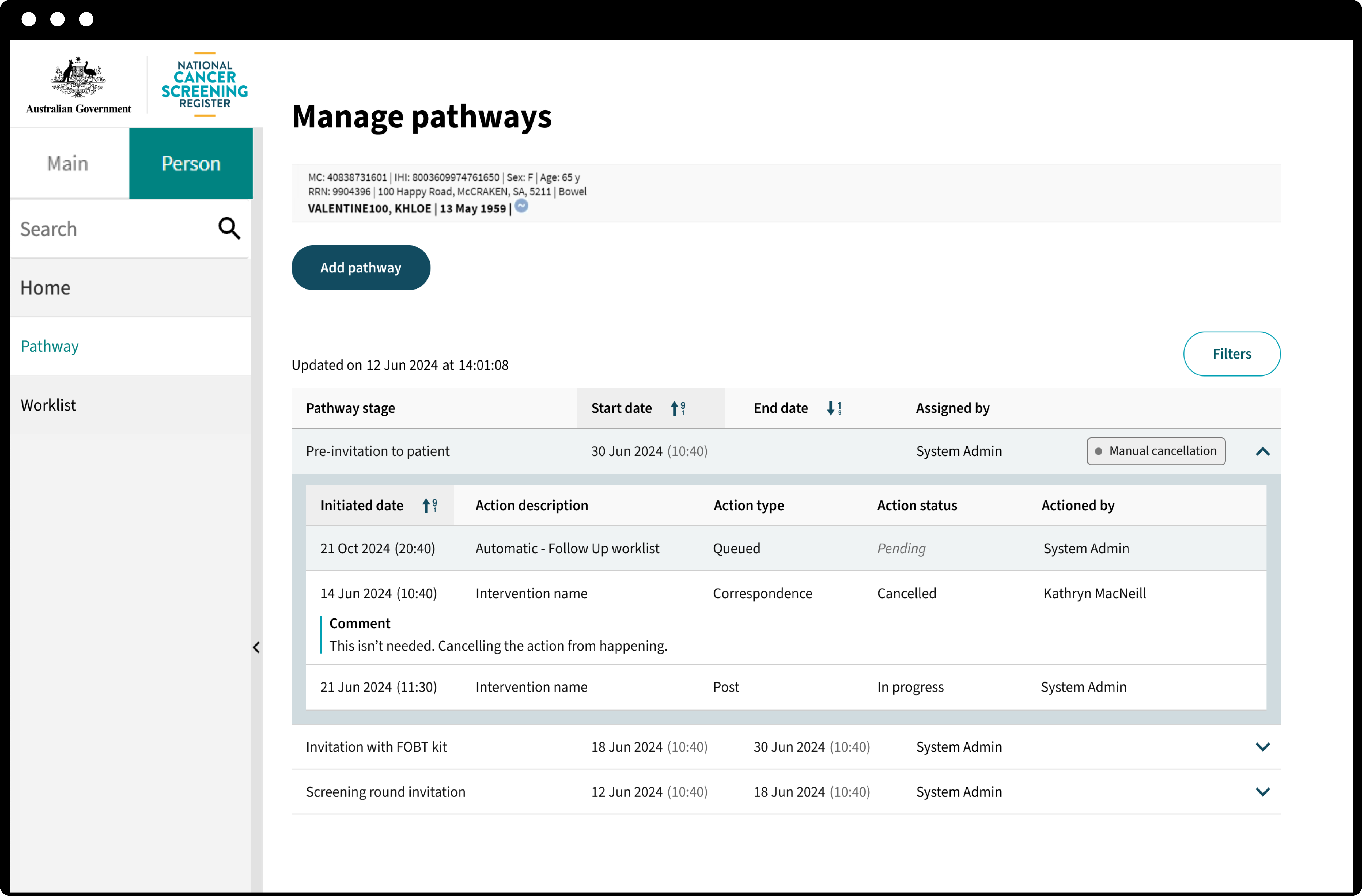
My Product Manager supported in the design decisions and together we oversaw the development adhering to the designs and managed to deliver upon the capabilities of the software platform to uphold for official public launch of the National Lung Cancer Screening Program in Australia.
Send a message if you want to hear more about this case study.